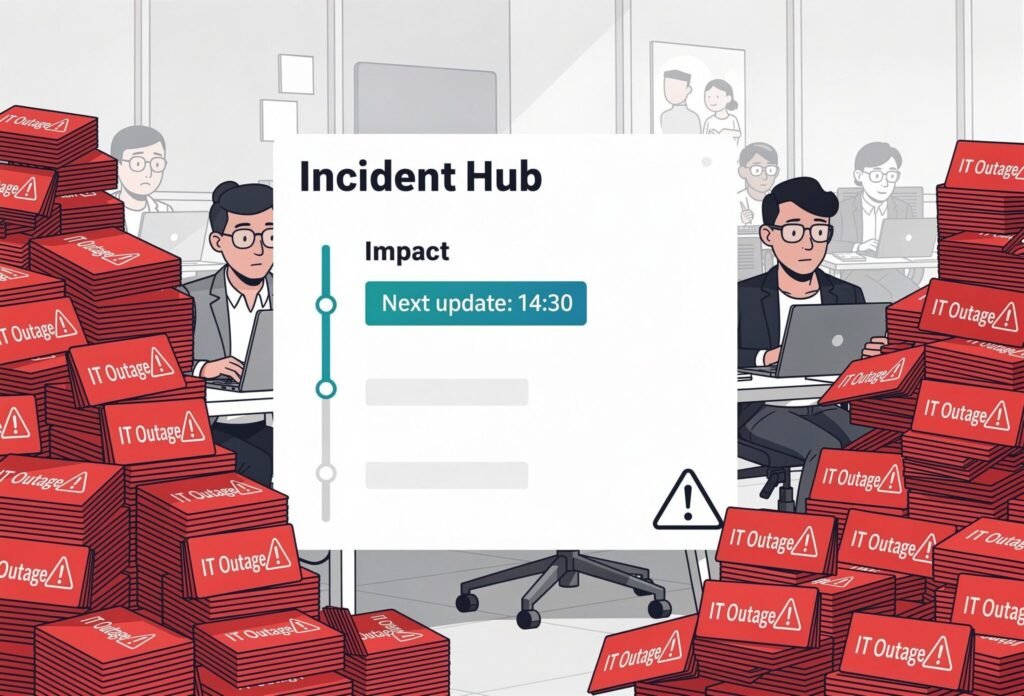
A status update arrives, gets skimmed for half a second, and disappears
under newer messages. Nothing breaks. Nothing changes. The incident
continues. The behavior reveals something uncomfortable: outage
communication has become a background condition, not an event.
Cut alert noise this week, regain trust fast
Define a severity contract in plain business language and publish it internally
Separate action-required messages from informational updates by default
Set an update budget per severity and stop sending messages when nothing changes
Reduce incident channels to one primary path per audience
Ship a one-page incident update template with a fixed structure
Assign an owner to review one incident timeline next Friday against engagement data
Incident communication fails when volume is treated as diligence instead of a design decision.
Alert fatigue is not apathy, it is conditioning
People do not ignore incident notifications because they are careless
about reliability. They ignore them because repeated exposure without
meaningful differentiation trains the brain to down-regulate attention.
In security operations research, alert desensitization is a documented
response to high-volume signaling where urgency cues lose their effect
once false positives and low-action messages dominate the stream, as
shown in research on alert fatigue in security operations centres
published by ACM Computing Surveys at
The Psychology of Alert Desensitization
.
The same mechanism plays out in enterprise IT communication. When every
incident update is labeled important, none of them are. Severity becomes
decorative. The cognitive system adapts. Attention moves elsewhere.
This is not a messaging problem. It is a learning problem. Organizations
teach users, week after week, that most outage notifications do not
require action, context, or memory. The rational response is to stop
reading them.
Information overload turns urgency into background noise
Information overload is no longer an edge case in enterprises. It is the
default operating condition. Harvard Business Review, drawing on Gartner
research, describes how constant streams of updates reduce comprehension,
decision quality, and perceived relevance once volume crosses a
threshold that individuals cannot actively manage, detailed in
Reducing Information Overload in Your Organization
.
Incident communication lands inside this environment. It competes with
chat, tickets, dashboards, newsletters, leadership notes, and the
never-ending “quick question” that is not quick. Adding more messages
does not increase awareness. It accelerates filtering.
There is a quiet irony here. Reliability teams communicate more because
they care. Users read less because they are overloaded. Both sides are
acting rationally. The system still fails.
ITIL optimizes resolution, not comprehension
ITIL incident management practices are strong on classification,
escalation, and resolution flow. They are nearly silent on whether
anyone understands, remembers, or acts on incident communication. The
canonical Incident Management Process summarized at
ITIL Incident Management Process
treats communication as an output, not a measurable system.
This creates a blind spot. Teams optimize for process completion rather
than message effectiveness. Sending updates becomes evidence of
compliance, not of impact. The question “Did we notify?” replaces “Did
anyone change behavior?”
Imagine a typical organization in which every major incident generates
an update every 30 minutes, regardless of change. The timeline looks
thorough. The audit trail is perfect. User comprehension steadily drops
after the second message. No one notices, because nothing requires them
to look.
The status page paradox: transparency that nobody checks
Many teams assume a status page solves the attention problem. It does
not. A status page is a pull channel. Most incident communication is
treated like a push channel. When you mix them without an explicit
design, you end up with the worst of both: constant pings and a “single
source of truth” nobody actually visits during work. Atlassian’s
guidance on incident messaging emphasizes clarity and audience focus in
Incident communication best practices
.
Here is the operational reality. In the first hour of an outage, people
want a simple answer: what is impacted, what to do, and when to check
again. In the third hour, they want fewer messages, not more. A status
page can carry depth. But the update stream must teach people that
checking it is worth their time.
If the status page becomes a dumping ground for raw technical notes, the
organization loses twice. Engineers waste time writing. Users learn the
page is unreadable. The next incident starts with a credibility deficit.
Notification UX breaks when severity becomes decoration
Most incident updates fail for the same reason bad UI notifications
fail: unclear intent. Is the message asking for action, offering
confirmation, warning of risk, or merely narrating progress? Nielsen
Norman Group’s guidance on notifications and system feedback shows how
ambiguous signals degrade trust and increase dismissal behavior in
Indicators, Validations, and Notifications
.
Severity inflation is the enterprise version of the “cry wolf” pattern.
When everything is SEV-1 in tone, users stop treating any signal as
meaningfully different.
Use one sentence to name impact in user language, not platform language
Use one sentence to state the required behavior, or explicitly state no action
Use one time cue that is real, even if it is “next update in 60 minutes”
Use one consistent structure so people can scan without decoding
Reserve the highest urgency cues for rare, action-critical moments
This is not aesthetics. It is survival. A notification system that
demands reading effort at scale will be defeated by human behavior. It
always is.
Engagement is the invisible dependency nobody budgets for
Incident communication assumes people are paying attention. That
assumption is expensive. If employees are disengaged, overloaded, or
operating in task survival mode, messages do not land the way leaders
think they do. Gallup’s recent reporting on weakened employee engagement
highlights how leadership and communication challenges show up as
confidence gaps and reduced discretionary effort in
Anemic Employee Engagement Points to Leadership Challenges
.
This matters for outages because incident updates often rely on
voluntary cooperation. Do not reboot. Do not retry the workflow. Avoid
manual workarounds. Check back later. These are behavior requests. They
require trust and attention.
A team can ship perfect technical updates and still fail if the
organization has trained users to treat corporate communication as
something that happens to them, not for them. The incident channel
inherits that reputation. It is not fair. It is true.
Make updates readable by design: timing, segmentation, one channel
The fix is not “communicate more clearly” as a slogan. The fix is to
treat incident notifications like a product with constraints:
segmentation, cadence, and properties that match the audience’s need.
Microsoft’s documentation for service health notification properties
shows how notification routing and scoped targeting can be configured as
a deliberate design choice in
Azure Service Health notifications overview
.
Three shifts change outcomes quickly.
First, segment the audience. The people who need workarounds are not the
same people who need technical detail. Mixing both in the same stream
creates unreadable messages for everyone.
Second, control cadence with an explicit “update budget.” If nothing
materially changes, silence is the most respectful update you can send.
Constant narration feels like activity. It functions like spam.
Third, enforce a one-channel rule per audience. When the same update
appears in email, chat, ticket banners, and intranet news, users learn
that the organization does not know where to put important information.
They respond by choosing their own channel. Usually, that channel is
none.
The goal is not transparency as performance. The goal is predictable,
low-effort comprehension under pressure.
We use technologies like cookies to provide you with the best possible experience. By consenting to these technologies, we can process data such as browsing behavior or unique IDs on this website.
If you choose not to consent or withdraw your consent later, certain features and functions may not work as intended.
Functional
Always active
The technical storage or access is strictly necessary for the legitimate purpose of enabling the use of a specific service explicitly requested by the user, or for the sole purpose of carrying out the transmission of a communication over an electronic communications network.
Präferenzen
Die technische Speicherung oder der Zugriff ist für den rechtmäßigen Zweck der Speicherung von Präferenzen erforderlich, die nicht vom Abonnenten oder Benutzer angefordert wurden.
Statistics
Die technische Speicherung oder der Zugriff, der ausschließlich zu statistischen Zwecken erfolgt.The technical storage or access that is used exclusively for anonymous statistical purposes. Without a subpoena, voluntary compliance by your Internet Service Provider, or additional records from a third party, the information stored or retrieved for this purpose alone cannot usually be used to identify you.
Marketing
The technical storage or access is required to create user profiles to send advertising, or to track the user on a website or across several websites for similar marketing purposes.