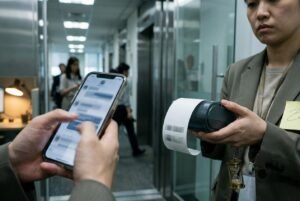
“Mobile-first Intranet” sounds like inclusion. In practice, it often means taking a desk-based model and shrinking it onto a phone screen. For deskless workers, that is not transformation. It is translation. And translation fails when the employee does not have a corporate identity, does not have a safe device, does not have time during a shift, and does not have a private moment to read a long post.
The result is predictable: Intranet adoption looks healthy in headquarters analytics, while frontline communication remains dependent on managers, printouts, and unofficial group chats. If your digital workplace strategy still assumes a seated worker with email, you are designing for the minority.
Reach Deskless Workers This Week Without Rebuilding the Intranet
List the five messages your frontline must never miss (safety, schedule changes, pay, policy, incident updates)
Choose one official reach channel per location: shared device, kiosk, digital signage, or manager-led huddle
Convert long Intranet posts into 3-card micro-briefs: what changed, what to do, where to get help
Use targeted mobile announcements for frontline teams (push plus lock-screen notification), not homepage browsing
Build one QR deep link per message that resolves to a single action or answer (not a navigation tree)
Implement a BYOD boundary: separate work container, minimal data capture, clear opt-in language, and a non-BYOD alternative
Measure success as behavior: acknowledgements, completions, and error reduction, not pageviews
If a channel requires free time, a private device, and perfect logins, it is not a frontline channel.
The workforce that never opens the Intranet
Deskless workers are not a special edge case. They are the operating majority in many industries. BCG highlights how fragile this segment can be, including signals such as burnout and churn pressure. In one BCG survey of deskless workers, 53% reported feeling burned out and 43% said they were actively or passively looking for a new job, as summarized in Making Work Work Better for Deskless Workers.
Now add the digital reality: many deskless roles have limited access to corporate communication systems that were designed for desk-based employees, leaving workers dependent on face-to-face updates and whatever information happens to be posted locally. This is the coverage gap most Intranet roadmaps ignore, and it is why deskless strategy must start with reach, not publishing, as discussed in BCG’s perspective on deskless labor and technology.
Why mobile first is not mobile enough
Mobile access helps only when the frontline reality is respected: shared devices, short sessions, limited attention windows, and the need for “one action, one answer” content. Microsoft’s guidance on Microsoft 365 for frontline workers is built around these constraints, including targeted communications, simplified access patterns, and scenarios that fit shift-based work.
The implication is uncomfortable: the Intranet homepage is the wrong interface for frontline work. What reaches deskless workers is not browsing. It is delivery: targeted announcements, short briefings, and fast answers inside the tools they can actually open during a shift.
The BYOD illusion: privacy, compliance, and the wall you hit
When organizations cannot issue devices at scale, they often default to BYOD and call it “coverage.” But BYOD is not just a technical rollout. It is a privacy and compliance negotiation. GDPR-focused guidance emphasizes the need for risk assessment, clear policy, security measures, and employee transparency when personal devices are used for work data, as outlined in BYOD GDPR compliance best practices.
BYOD only works when there is a credible alternative for those who do not want to use a private phone. Otherwise, “choice” becomes pressure, and pressure becomes resistance.
What actually reaches deskless workers: channels that work
Frontline communication succeeds when it behaves like operations: timely, targeted, and frictionless. This matters even more in an engagement climate where global engagement is low, as shown in Gallup’s Global Indicator: Employee Engagement.
So the strategy is not “drive people to the Intranet.” The strategy is “meet people where the shift happens.” Practical reach channels typically include:
Targeted mobile announcements (push notification plus brief card)
Digital signage (high-frequency reminders, safety, deadlines)
Kiosks (one-touch access to policies, directories, checklists)
Manager-led micro-huddles (reinforce the message, capture feedback)
Digital signage, kiosks, and the return of physical touchpoints
Deskless communication is often physical before it is digital: corridors, break rooms, shift start points. That’s why digital signage and kiosks are not “old school.” They deliver information where the workforce actually passes, and they reduce friction in real environments. Appspace frames these touchpoints as internal communications channels and highlights interactive kiosk use cases in its overview of digital signage for internal communications.
The Intranet can still be the source of truth. But frontline reach often requires both a broadcast layer and a touchpoint layer.
Measuring what matters: from reach to behavioral change
Frontline communication fails when success is measured as “published.” What matters is whether behavior changed: did the safety step happen, did the shift update land, did the policy acknowledgement increase, did incidents drop? ISO 30414:2018 positions human capital measures as decision support for internal stakeholders, reinforcing that measurement should enable management action, not vanity reporting. For practical interpretation, the Conference Board overview of ISO 30414 can help translate the standard into management-ready measures.
A practical measurement model for deskless reach:
Reach: who had exposure (by location/shift)
Acknowledgement: who confirmed receipt (one tap)
Action: completion of the required step (checklist, form, training micro-unit)
Deskless workers do not need a smaller Intranet. They need a different delivery model: fewer steps, shorter content, multiple touchpoints, and metrics tied to action. Beyond mobile first means treating frontline communication as an operational system, not a publishing channel.
We use technologies like cookies to provide you with the best possible experience. By consenting to these technologies, we can process data such as browsing behavior or unique IDs on this website.
If you choose not to consent or withdraw your consent later, certain features and functions may not work as intended.
Functional
Always active
The technical storage or access is strictly necessary for the legitimate purpose of enabling the use of a specific service explicitly requested by the user, or for the sole purpose of carrying out the transmission of a communication over an electronic communications network.
Präferenzen
Die technische Speicherung oder der Zugriff ist für den rechtmäßigen Zweck der Speicherung von Präferenzen erforderlich, die nicht vom Abonnenten oder Benutzer angefordert wurden.
Statistics
Die technische Speicherung oder der Zugriff, der ausschließlich zu statistischen Zwecken erfolgt.The technical storage or access that is used exclusively for anonymous statistical purposes. Without a subpoena, voluntary compliance by your Internet Service Provider, or additional records from a third party, the information stored or retrieved for this purpose alone cannot usually be used to identify you.
Marketing
The technical storage or access is required to create user profiles to send advertising, or to track the user on a website or across several websites for similar marketing purposes.